
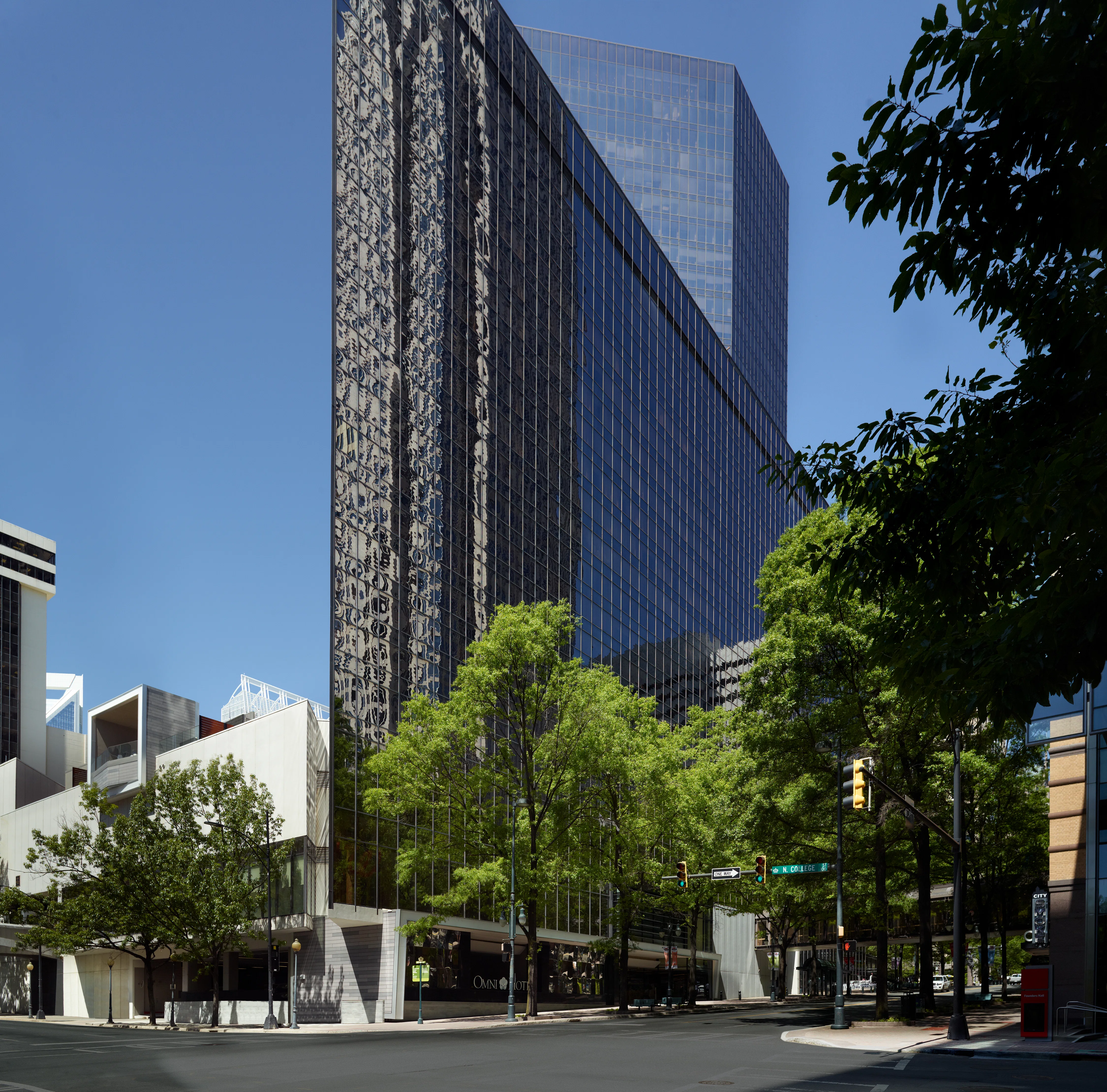
The Omni Charlotte Hotel operates as a foundational component of Charlotte's Uptown convention cluster, situated alongside the Charlotte Convention Center, NASCAR Hall of Fame, and several other full-service hotels. This concentration supports programs that transition efficiently between lodging, meeting spaces, exhibit areas, and hospitality functions without requiring extensive off-site transportation. Planners use this setup to maintain attendee momentum across multi-day schedules while drawing on the surrounding infrastructure that includes more than 200 restaurants and bars within walking distance.
Charlotte Douglas International Airport's record of 53.6 million passengers in 2025 and nonstop service to over 188 destinations supplies the connectivity necessary for national and international audiences to reach Uptown events with minimal disruption. The region's 3.2 million residents, 1.7 million labor force participants, and 13 percent five-year workforce growth create a deep pool of potential attendees and operational support. Nineteen Fortune 1000 headquarters across financial services, manufacturing, technology, and other sectors generate consistent demand for targeted conferences, product demonstrations, and executive gatherings that align with the hotel's capabilities.
Effective coordination at the Omni Charlotte Hotel requires integrating the property's role within the broader ecosystem managed by the CRVA, including its 600,000-square-foot convention center campus that features 280,000 square feet of exhibit space and 154,000 square feet of breakout space. This environment favors finance-led events, advanced manufacturing supplier meetings, motorsports hospitality, and technology innovation programs that benefit from both scale and urban accessibility.
Verified venue facts for Omni Charlotte Hotel: Strategic Event Planning in Charlotte, NC
- Charlotte Meetings lists the Omni Charlotte Hotel at 132 E Trade Street in Uptown Charlotte.
- Its destination section lists 16,000 square feet of meeting space, a 7,230-square-foot largest room, and 374 guest rooms.
- Official amenities include pool, fitness, food and beverage, and parking access.
Uptown Convention Core Positioning
The Omni Charlotte Hotel belongs to a tightly integrated group of venues that defines Charlotte's primary meeting district. This cluster combines hotel meeting space with the Charlotte Convention Center and NASCAR Hall of Fame to create an environment where logistics remain contained within a pedestrian-friendly zone. Official Charlotte Meetings documentation highlights this concentration as a competitive advantage that allows organizers to deliver smooth attendee journeys from arrival through educational sessions, exhibits, and evening networking.
Programs held here gain from proximity to nightlife and dining options that extend the event experience beyond formal sessions. The unified destination sales and marketing structure maintained by the CRVA helps synchronize calendars across these assets, reducing conflicts and enhancing overall program cohesion. Planners focused on exhibit-heavy conferences or sponsorship-driven gatherings find this configuration particularly effective because it concentrates foot traffic and maximizes unplanned interactions that strengthen business outcomes.
The surrounding infrastructure supports both large-scale conventions and more focused corporate events. By understanding traffic flows between the Omni Charlotte Hotel, convention facilities, and adjacent hotels such as the Westin Charlotte, Hilton Charlotte Uptown, Charlotte Marriott City Center, and JW Marriott Charlotte, coordinators can schedule sessions, receptions, and activations to maintain high engagement levels throughout the event lifecycle.
- Charlotte Convention Center
- NASCAR Hall of Fame
- The Westin Charlotte
- Hilton Charlotte Uptown
- Charlotte Marriott City Center
- JW Marriott Charlotte
Airport Access and National Reach
Charlotte Douglas International Airport's capacity of 53.6 million passengers in 2025 combined with nonstop flights to more than 188 destinations provides exhibitors and attendees with direct, efficient access to Uptown Charlotte. This level of connectivity distinguishes the market and allows the Omni Charlotte Hotel to host programs that draw participants from across the United States and international markets without the complications of multiple layovers or extended ground transfers.
The airport's scale supports tight event schedules where field teams and corporate representatives can arrive, participate fully, and depart with minimal downtime. Logistics coordinators factor these patterns into registration timing, session sequencing, and hospitality calendars to reduce fatigue and increase productive face-to-face time. The presence of more than 1,000 international businesses and 8,400 jobs created through foreign direct investment since 2022 further reinforces the value of venues that sit minutes from this global gateway.
Event planners use this accessibility to build truly national attendee lists for conferences in financial services, life sciences, and technology. The resulting diversity of perspectives elevates panel discussions, product launches, and networking components while simplifying the recruitment of specialized speakers and sponsors who value convenient travel.
Industry Demand Drivers and Program Alignment
Charlotte maintains its position as the second-largest financial center in the United States, generating sustained demand for banking and financial services conferences that frequently incorporate hotel ballrooms and breakout rooms at properties such as the Omni Charlotte Hotel. These events typically blend regulatory updates, technology demonstrations, and executive recruiting elements that require both formal presentation space and informal networking areas supported by the Uptown environment.
Advanced manufacturing, life sciences and healthcare, logistics, motorsports and automotive, and technology and corporate innovation each contribute distinct requirements that map effectively to the hotel's setting. Motorsports-related programs draw on the proximity to Charlotte Motor Speedway assets to extend brand activations and VIP hospitality into hotel spaces. Technology and innovation gatherings benefit from the region's headquarters density, using the venue for product reveals and collaborative workshops.
The 19 Fortune 1000 companies headquartered in the 15-county region supply both audiences and content experts, creating a self-reinforcing cycle of event activity. Planners must map these verticals to specific session formats, exhibit requirements, and sponsorship tiers to ensure relevance and measurable return on investment for all stakeholders.
- Banking and financial services
- Advanced manufacturing
- Life sciences and healthcare
- Logistics and international business
- Motorsports and automotive
- Technology and corporate innovation
Convention Center Integration and Capacity Planning
The Charlotte Convention Center's 280,000 square feet of exhibit hall space and 154,000 square feet of breakout space create natural synergies with the Omni Charlotte Hotel for hybrid programs that distribute activities across both locations. This combination allows organizers to host large trade floor components in the convention facility while conducting targeted educational tracks, sponsor suites, and executive dinners in the hotel. The 6,400 walkable hotel rooms in the district simplify housing logistics for multi-night stays.
CRVA's unified management of the convention center, NASCAR Hall of Fame, and Bojangles Entertainment Complex streamlines permitting, scheduling, and support services across the core. Coordinators who map these relationships early can avoid bottlenecks in move-in, audiovisual setup, and attendee circulation. The resulting efficiency supports tighter budgets and higher production values within the same overall investment.
Programs that begin with registration at the hotel and flow into convention exhibits maintain attendee energy through short walking distances and consistent theming. This integrated approach proves especially effective for industry events that combine compliance training, product showcases, and relationship-building components within a single, compact footprint.
Economic Momentum and Workforce Dynamics
The Charlotte region's 3.2 million population and 1.7 million-member labor force, which expanded 13 percent over five years, provide both robust attendee pools and operational depth for events at the Omni Charlotte Hotel. The metro area's second-place national ranking for job growth among large metros at the close of 2025 signals continued corporate expansion that translates into steady demand for conferences, training programs, and supplier expos.
Nineteen Fortune 1000 headquarters spanning financial services, retail, manufacturing, aerospace, and technology create a concentration of decision-makers who prefer centrally located venues with strong connectivity. Foreign direct investment trends that added more than 8,400 jobs since 2022 and established over 1,000 international businesses expand the potential for cross-border events that require sophisticated coordination of cultural, regulatory, and logistical elements.
These economic indicators influence planning decisions around audience size, content complexity, and sponsorship expectations. Coordinators who track workforce growth patterns can better anticipate shifts in attendee profiles and adjust program formats to maintain relevance as the market evolves.
Coordination Best Practices for Hotel-Based Events
Successful programs at the Omni Charlotte Hotel begin with detailed mapping of session flow, technology requirements, and sponsor integration points against the property's physical layout and neighboring convention schedules. Early decisions regarding audiovisual infrastructure, furniture configurations, and digital engagement tools prevent downstream adjustments that could compromise attendee experience or increase costs.
Sponsorship activation zones perform best when aligned with natural circulation patterns between the hotel, convention center, and Uptown dining districts. Timing receptions and networking periods to coincide with nearby entertainment options extends engagement while respecting hotel operational boundaries. Planners also monitor overlapping citywide events to identify collaboration opportunities or avoid audience fragmentation.
The CRVA's destination management framework supplies current data on hotel inventory, transportation patterns, and regional economic signals that inform adaptive decision-making. Programs that incorporate these resources typically achieve higher satisfaction scores and more effective measurement of return on investment across both quantitative attendance metrics and qualitative relationship outcomes.
- Map session sequences against hotel layout and convention center calendars
- Align sponsorship zones with documented attendee circulation patterns
- Finalize technology and AV specifications during initial planning phases
- Incorporate Uptown dining and nightlife into daily programming schedules
- Track workforce and FDI data to refine attendee targeting and content
- Coordinate with unified CRVA resources for consistent regional alignment
Connecting to Complementary Venue Clusters
While the Omni Charlotte Hotel excels within the Uptown core, many programs achieve greater impact by deliberately linking to the Concord-Cabarrus corridor that includes the Embassy Suites Charlotte Concord, Cabarrus Arena & Events Center, and Charlotte Motor Speedway. These assets support larger drive-in audiences, experiential builds, and enthusiast activations that complement the more compact, business-focused environment of Uptown hotels.
The adaptive reuse and activation zone encompassing Camp North End, the Fillmore, Spectrum Center, and Truist Field offers distinctive atmospheric options for evening events or brand launches that contrast with traditional hotel aesthetics. South Charlotte corridors around the Ballantyne Hotel and Harris Conference Center provide executive-level settings for smaller, high-touch programs targeting different decision-maker segments than those drawn to Uptown.
Effective planning resources evaluate these relationships during the initial concept phase to construct cohesive multi-venue calendars that leverage each location's strengths. This approach maximizes the Charlotte market's full inventory while maintaining logical attendee progression and operational efficiency across the region.
Planning Questions for the Omni Charlotte Hotel
How does the Omni Charlotte Hotel fit into Charlotte's broader convention infrastructure?
The hotel forms part of the Uptown convention core that integrates directly with the Charlotte Convention Center's 280,000 square feet of exhibit space, the NASCAR Hall of Fame, and more than 6,400 walkable hotel rooms. This cluster supports conventions, ballroom breakouts, sponsor events, and programs that benefit from proximity to dining and nightlife.
What role does Charlotte Douglas International Airport play for events at this venue?
The airport managed 53.6 million passengers in 2025 with nonstop service to over 188 destinations. This connectivity enables planners to assemble national and international audiences efficiently for programs based at the Omni Charlotte Hotel and throughout Uptown Charlotte.
Which industries drive consistent demand for Uptown hotel events?
Banking and financial services, advanced manufacturing, life sciences, logistics, motorsports, and technology sectors generate ongoing activity. The region's status as the second-largest U.S. Financial center and home to 19 Fortune 1000 companies sustains diverse conference and exhibition calendars.
How does regional workforce growth affect event coordination?
A 13 percent five-year labor force expansion and second-ranked job growth among large metros create both larger potential attendee pools and greater operational capacity. These trends support more sophisticated programs that draw on local corporate headquarters and international business activity.
Can programs at the Omni Charlotte Hotel connect to other Charlotte venue clusters?
Yes. Strategic plans frequently link Uptown events to the Concord-Cabarrus corridor, South Charlotte executive venues, or activation-focused spaces. This multi-cluster approach allows coordinators to match specific session types with the most suitable locations while maintaining overall program cohesion.