
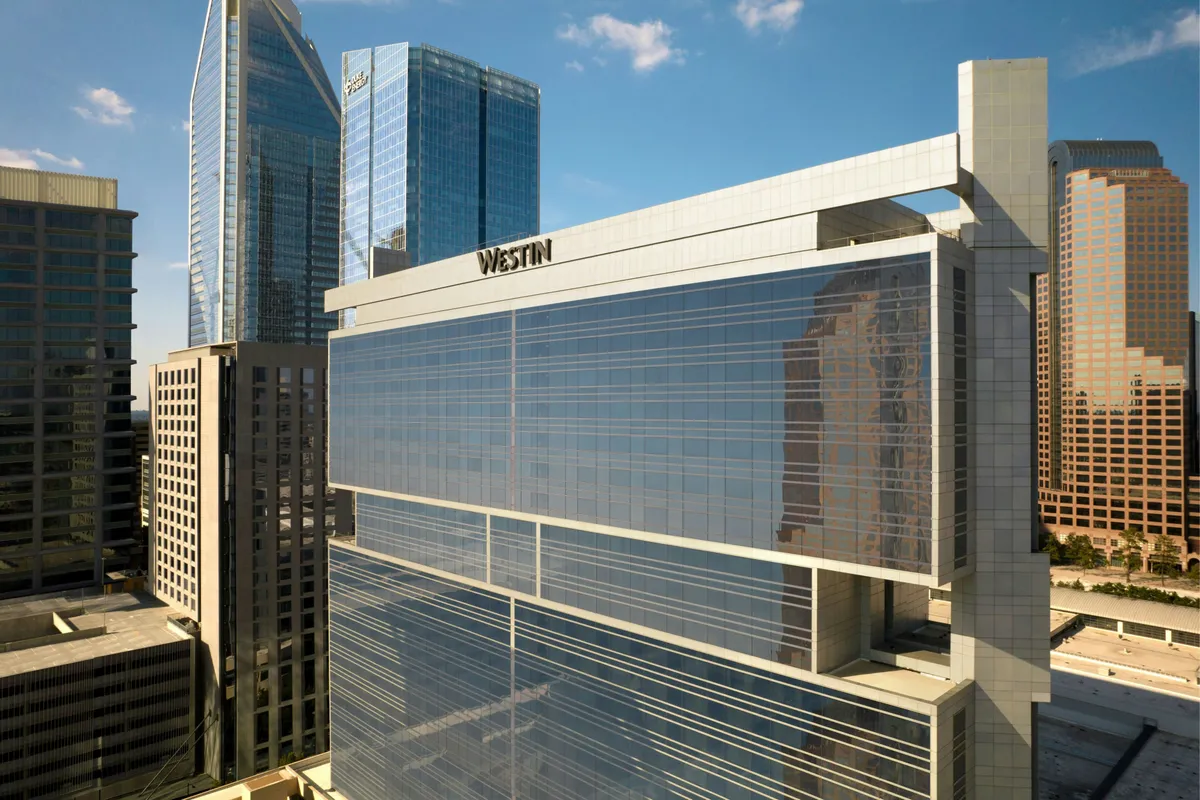
The Westin Charlotte anchors a prime segment of the Uptown Convention Core where sophisticated hotel meeting facilities sit steps from the Charlotte Convention Center and NASCAR Hall of Fame. This positioning supports conventions, exhibit-linked conferences, ballroom breakouts, and sponsor activations that capitalize on walkable hotels, abundant dining, and unified destination management. Planners gain efficiency by blending the venue's refined environment with the broader 600,000-square-foot convention infrastructure that includes 280,000 square feet of exhibit space and 154,000 square feet of breakout rooms.
Charlotte has solidified its role as the Southeast's premier meeting destination through consistent economic momentum, global air connectivity, and a cluster of Fortune 1000 headquarters. The region's 3.2 million residents, 1.7 million-member labor force, and 13 percent five-year workforce growth create reliable attendance pools while 19 Fortune 1000 companies across financial services, manufacturing, technology, and aerospace drive targeted program demand. Events at the charlotte therefore benefit from a market where corporate, innovation, and industry-specific gatherings align naturally with the venue's central location and the CRVA's coordinated sales and operations structure.
As an authoritative coordination resource, this guide outlines practical considerations drawn from verified market data to help organizers design and sequence successful programs at the charlotte without relying on unconfirmed operational details.
Verified venue facts for The Westin Charlotte for Trade Shows and Conferences in Uptown
- Charlotte Meetings lists The Westin at 601 S College Street in Uptown Charlotte.
- Its destination section lists 47,742 square feet of meeting space, a 16,276-square-foot largest room, and 700 guest rooms.
- Charlotte Meetings homepage identifies it as the 700-room hotel across the street from the convention center.
The Westin Charlotte Within the Uptown Convention Core
The charlotte participates in one of the market's most connected venue groupings that pairs hotel ballrooms and meeting rooms with the full scale of the Charlotte Convention Center. This core cluster supports programs ranging from exhibit-heavy conferences to sponsor-focused receptions where attendees move easily between formal sessions, networking dinners, and entertainment options. Official Charlotte Meetings materials emphasize the convenience of more than 200 restaurants and bars within walking distance, which extends the value of any event held at the charlotte by providing ready venues for informal client engagements and team gatherings.
The CRVA's unified management of the convention center, NASCAR Hall of Fame, and related assets creates operational consistency across the district. Planners can therefore sequence multi-day programs that use the charlotte for executive sessions or smaller-scale exhibits while routing larger displays or general sessions into the neighboring 600,000-square-foot facility. This arrangement reduces attendee friction and simplifies transportation logistics within the Uptown footprint.
Charlotte's convention inventory supports both established expos and emerging corporate events. With the city's position as the second-largest financial center in the United States, programs at the charlotte frequently incorporate financial-services themes, recruiting components, or sponsorship activations that draw from the deep executive pool headquartered throughout the region.
- Direct adjacency to the Charlotte Convention Center's 280,000 square feet of exhibit space
- Access to 154,000 square feet of dedicated breakout and meeting rooms nearby
- Proximity to NASCAR Hall of Fame for branded or hospitality extensions
- Walkable connection to nightlife and dining that supports extended attendee stays
Market Demand Drivers Shaping Programs at the Westin Charlotte
Charlotte's economy features 19 Fortune 1000 headquarters spanning banking, retail, manufacturing, aerospace, and technology. This concentration generates steady requirements for conferences, supplier exhibitions, product launches, and leadership forums that match the polished setting and breakout capabilities offered at the charlotte. The region's second-place national ranking for job growth among large metros further expands the pool of professional attendees who can participate with minimal travel disruption.
Advanced manufacturing and logistics sectors benefit from the market's top-10 manufacturing position and its role as a foreign-direct-investment magnet that has added more than 8,400 jobs since 2022. Events focused on these industries often combine education sessions at the charlotte with demonstration areas in the convention center or hospitality at motorsports-linked assets. Life-sciences and healthcare programs similarly find compliant, centrally located space that supports both clinical education and commercial exhibition needs.
Motorsports and automotive categories receive particular lift from the nearby NASCAR Hall of Fame and the broader Concord corridor. Planners can extend programs with experiential elements or VIP receptions that capitalize on the region's authentic racing heritage while maintaining walkable convenience for all participants.
- Banking and financial services as the anchor demand category
- Advanced manufacturing and supplier network events
- Life-sciences congresses requiring precise execution
- Technology innovation and corporate off-site conferences
- Motorsports brand launches and enthusiast hospitality
Transportation Infrastructure and Attendee Access
Charlotte Douglas International Airport recorded 53.6 million passengers in 2025 while offering nonstop service to more than 188 destinations. This connectivity gives exhibitors and field teams from across the country unusually direct routing into events at the charlotte, shortening lead times and reducing travel fatigue compared with markets that require multiple connections. International businesses now number more than 1,000 in the region, further justifying programs that draw global participants.
Interstate access complements the airport by enabling strong drive-in attendance from the 15-county Charlotte Region. The combination of air and ground options allows planners to balance national keynote speakers with robust regional participation drawn from the 1.7 million-person labor force. Uptown's compact layout then minimizes on-site transit once attendees reach the Westin and its neighboring venues.
These transportation strengths reinforce the decision to locate events at the charlotte when the objective includes both high-level corporate attendance and broad industry representation. The market's continued population and workforce expansion suggest that future programs will see even larger potential audiences without requiring changes to core venue strategy.
Coordination Best Practices for Multi-Venue Programs
Successful events at the charlotte typically integrate with the surrounding convention infrastructure rather than operating in isolation. This requires precise scheduling of registration, move-in, educational sessions, exhibit hours, and evening functions so that flow remains smooth between the hotel, convention center, and adjacent hospitality assets. Attention to these transitions maximizes productive time for attendees and reduces operational friction for organizers.
The CRVA's destination-wide approach supplies a stable planning backdrop that includes standardized procedures across key Uptown sites. Organizers benefit from this framework when designing hybrid programs that use the charlotte for intimate boardroom-style meetings or sponsor dinners while directing larger crowds into the convention center's exhibit halls. Early mapping of attendee journeys and stakeholder responsibilities helps maintain clarity throughout the planning timeline.
Post-event evaluation also gains depth when viewed through the lens of Charlotte's larger economic signals. Metrics can incorporate not only session attendance but also indicators of market momentum such as corporate headquarters participation or alignment with high-growth sectors. This broader perspective helps demonstrate return on investment to sponsors and future budgeting committees.
- Sequence ballroom breakouts with convention center exhibit hours
- Align sponsor activations with walkable nightlife opportunities
- Map attendee movement between the Westin Charlotte and NASCAR Hall of Fame
- Coordinate with regional workforce growth patterns for targeted promotion
Industry Alignment and Program Customization
Financial-services conferences at the charlotte draw on Charlotte's status as the nation's second-largest banking center. These programs often feature recruiting pavilions, compliance-focused education tracks, and executive networking that fit naturally within the hotel's upscale environment. Proximity to the convention center allows expansion into larger exhibition components when needed without losing the polished atmosphere preferred by this audience.
Manufacturing and logistics events capitalize on the CLT Alliance's portrait of a top-tier industrial market supported by foreign investment and robust supply chains. Sessions held at the charlotte can address workforce development, technology integration, or distribution strategies while demonstrations or heavy equipment displays route to appropriate convention space. The market's 13 percent five-year labor-force growth supplies a ready audience of professionals interested in these topics.
Motorsports-linked programs gain authenticity from the adjacent NASCAR Hall of Fame and the wider corridor that includes Charlotte Motor Speedway. The charlotte serves well for premium hospitality, media briefings, or brand-strategy sessions that complement experiential elements staged elsewhere in the Uptown or Concord clusters. Technology and innovation events similarly use the venue's central location to convene headquarters decision-makers from across the 19 Fortune 1000 companies headquartered in the region.
Long-Term Strategic Value of Charlotte Events
Charlotte continues to strengthen its convention credentials through population growth, job momentum, and deliberate investment in meeting infrastructure. The charlotte therefore represents more than a single-year choice; it anchors programs within an ecosystem projected to sustain increasing demand across multiple industry verticals. Organizers who build relationships with this market position themselves to scale future events as workforce and corporate footprints expand.
The unified CRVA structure and the emphasis on walkable, mixed-use convention districts create repeatable efficiencies that reduce planning overhead over time. As the region adds international businesses and maintains its ranking for job creation, events at the charlotte gain access to progressively deeper pools of decision-makers and technical talent. This trajectory supports multiyear event calendars rather than one-off activations.
Effective coordination remains centered on verified market realities: global air access, corporate headquarters density, diverse demand drivers, and integrated venue clusters. Programs designed around these constants deliver measurable value whether the immediate focus is financial services recruiting, manufacturing supplier days, life-sciences education, or motorsports brand engagement.
- 19 Fortune 1000 headquarters driving executive attendance
- Second-largest U.S. Financial center supporting specialized conferences
- Top-tier manufacturing and logistics footprint
- Ongoing foreign direct investment adding new business audiences
Practical Timeline and Preparation Steps
Early engagement with destination resources allows sufficient time to align the charlotte space with complementary convention center availability and regional stakeholder calendars. Site selection, room block coordination, and exhibit logistics all benefit from data on Charlotte's peak periods and the flow patterns typical of Uptown events. Incorporating airport arrival statistics and labor-force growth figures into promotion strategies further refines expected attendance.
Mid-stage planning focuses on session architecture, sponsor integration, and attendee experience mapping that highlight the convenience of the Uptown core. Final execution checkpoints verify that all elements remain synchronized with the CRVA's operational standards and the venue capabilities documented in official planning guides. This disciplined approach converts market advantages into on-site results without introducing unnecessary variables.
Review cycles after the event should capture both quantitative metrics and qualitative feedback tied to Charlotte-specific strengths such as transportation ease, corporate relevance, and the supportive density of restaurants and hotels. These insights inform subsequent iterations and help demonstrate sustained value to leadership and sponsoring organizations.
Common Questions on Planning at the Westin Charlotte
How does the Westin Charlotte connect to larger convention activity in Charlotte?
The hotel forms part of the Uptown Convention Core alongside the Charlotte Convention Center's 280,000 square feet of exhibit space and 6,400 walkable hotel rooms, enabling smooth programs that combine ballroom sessions with full-scale exhibitions and NASCAR Hall of Fame activations.
What market factors support attendance for events at this venue?
Charlotte's 19 Fortune 1000 headquarters, 13 percent five-year workforce growth, second-place national job-growth ranking, and position as the second-largest U.S. Financial center create consistent demand across banking, manufacturing, life sciences, technology, and motorsports sectors.
Why is air access important for programs at this work?
Charlotte Douglas International Airport handled 53.6 million passengers in 2025 with nonstop flights to more than 188 destinations, giving national and international exhibitors and attendees direct, efficient routing into Uptown events.
Which industries align best with the program?
Finance and banking for executive conferences, advanced manufacturing and logistics for supplier events, life sciences for compliant educational programs, motorsports for brand hospitality, and technology for innovation forums all match the venue's central, professional setting.
How does Uptown's walkability affect event planning?
More than 200 restaurants and bars within walking distance, combined with direct connections to the convention center and sports venues, allow planners to extend the experience with networking dinners, client receptions, and informal meetings without additional transportation requirements.