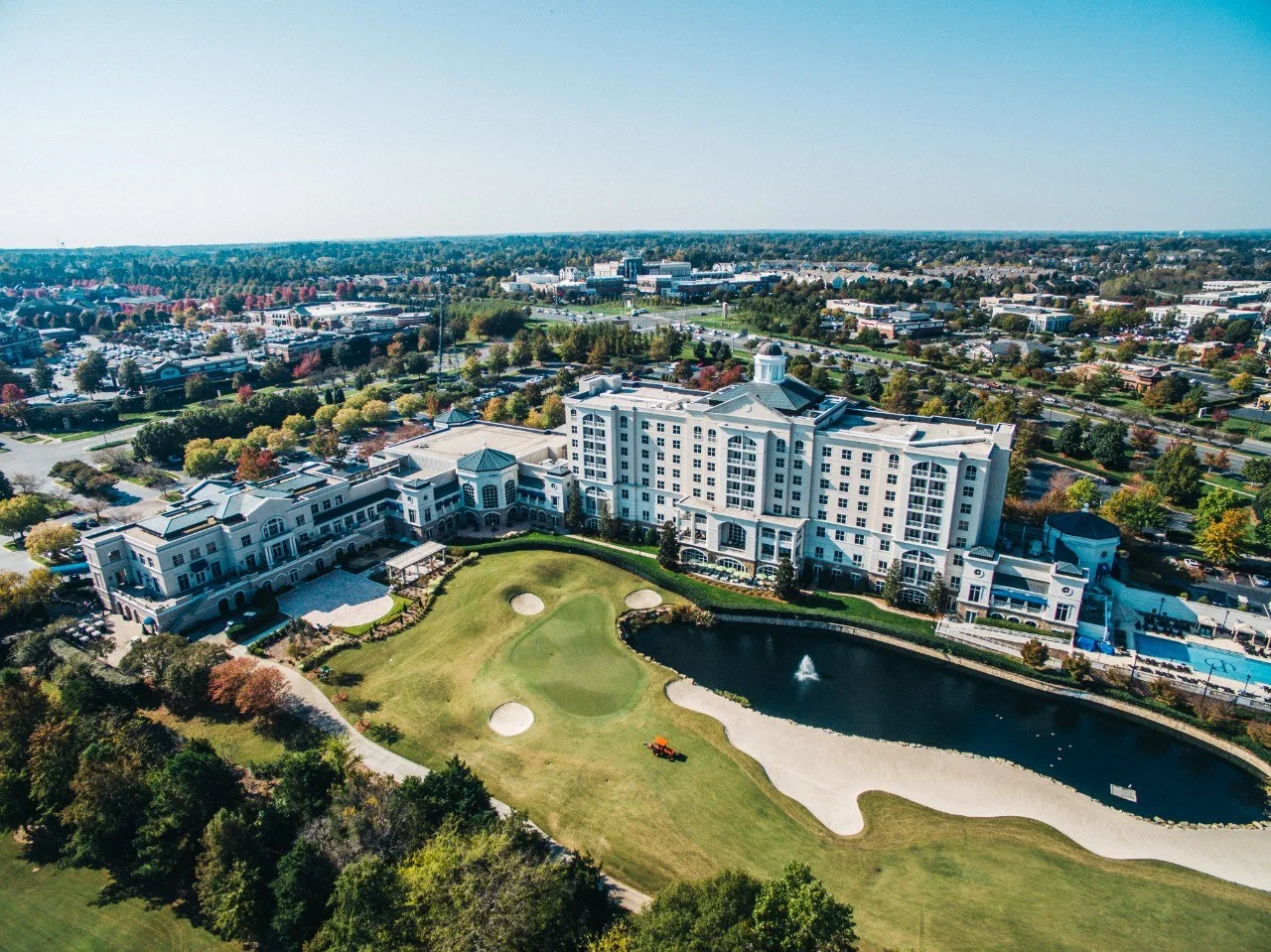
Ballantyne functions as a key node in Charlotte’s south executive corridor, offering polished hospitality suited to leadership summits, professional development programs, client engagements, and selective trade exhibitions. The district’s upscale environment allows planners to create focused experiences that resonate with corporate audiences while maintaining straightforward connections to the wider Charlotte market. This balance proves especially valuable for organizations that require both intimacy and scalability without the density of pure convention-core locations.
The broader Charlotte region strengthens these efforts through exceptional air connectivity, substantial corporate density, and a unified destination management framework. Charlotte Douglas International Airport processed 53.6 million passengers in 2025 with nonstop flights to more than 188 destinations, enabling efficient national and international participation. Meanwhile, the Charlotte Convention Center supplies 280,000 square feet of exhibit space within a 600,000-square-foot facility, allowing programs that originate in Ballantyne to expand when appropriate.
Economic indicators further support strategic event placement here. The 15-county Charlotte Region counts 3.2 million residents, a 1.7 million labor force, and 13 percent workforce growth over five years. The metro ranked second nationally for job growth among large markets by the close of 2025, backed by 19 Fortune 1000 headquarters and more than 1,000 international businesses.
Ballantyne’s Position in South Charlotte Executive Programs
The Ballantyne area has developed a reputation for refined venues that serve executive-level gatherings particularly well. The Ballantyne, a Luxury Collection Hotel, and the Harris Conference Center deliver environments optimized for training sessions, advisory boards, product briefings, and mid-sized industry showcases where relationship-building and focused dialogue take precedence. These properties sit within a corporate corridor that places decision-makers in close proximity, reducing transit times and increasing productive engagement during event days.
Planners often select Ballantyne when the objective centers on quality interactions rather than maximum square footage. Its location offers a professional counterpoint to larger, higher-traffic zones while remaining tightly linked to Charlotte’s overall infrastructure. This makes it possible to host initial executive components in the south before transitioning larger groups to complementary sites without logistical disruption.
Effective coordination begins by mapping program goals against these venue characteristics. Attention to attendee profiles, session formats, and support requirements allows resource allocation that maximizes impact within the distinct atmosphere Ballantyne provides.
Global Connectivity Through Charlotte Douglas International Airport
Charlotte Douglas International Airport represents a foundational asset for any Ballantyne-centered program. In 2025 the facility managed 53.6 million passengers while offering nonstop service to more than 188 destinations. This reach gives exhibitors, speakers, and field teams from across the United States and overseas direct routing options that minimize layovers and reduce overall travel fatigue.
For national trade associations or corporations with distributed operations, the airport’s scale translates into higher attendance potential and simpler scheduling. Ground transportation from the airport to Ballantyne remains predictable, supporting tight agendas that include early-morning sessions or same-day departures. Coordination teams therefore incorporate flight data into site selection and agenda design from the earliest stages.
The combination of extensive air service and south Charlotte’s executive focus creates a competitive edge for mid-sized programs that might otherwise struggle to attract distant participants. Planners who map these transportation realities early avoid last-minute adjustments and maintain tighter control over budgets and outcomes.
Linking Ballantyne to Charlotte’s Major Convention Resources
The Charlotte Convention Center anchors the market with 600,000 square feet of total space, including 280,000 square feet of dedicated exhibit hall area and 154,000 square feet of breakout rooms. More than 6,400 hotel rooms within walking distance in Uptown allow smooth expansion of programs that begin with smaller Ballantyne components. This layered inventory enables planners to right-size each segment of a multi-day schedule.
The CRVA maintains unified oversight of destination sales, marketing, and venue operations that include the NASCAR Hall of Fame and Bojangles Entertainment Complex. This centralized structure simplifies permitting, cross-promotion, and support service coordination regardless of primary location. Programs can therefore open with targeted sessions at the Harris Conference Center before moving key cohorts to Uptown for larger exhibit or networking elements.
Such integration rewards advance planning. Teams that map attendee flow, technology requirements, and support logistics across clusters achieve smoother execution and higher satisfaction scores. Ballantyne’s role as an entry point or executive track within these larger calendars has become a recognized pattern among experienced coordinators.
- 280,000 square feet of exhibit hall space at the Charlotte Convention Center
- 154,000 square feet of breakout and meeting space
- More than 6,400 hotel rooms walkable to Uptown venues
- Unified CRVA management across convention, entertainment, and support assets
Corporate Headquarters and Economic Momentum Driving Attendance
Nineteen Fortune 1000 companies maintain headquarters in the Charlotte Region across financial services, retail, food services, manufacturing, aerospace, and technology. The presence of more than 1,000 international businesses and 8,400 new jobs created through foreign direct investment since 2022 further expands the pool of potential attendees and sponsors. These organizations generate consistent demand for targeted education, product demonstrations, and peer networking that trade shows can fulfill.
The region’s 3.2 million population and 1.7 million labor force have experienced 13 percent workforce growth over five years. By the end of 2025, Charlotte ranked second nationally for job growth among large metros. This expansion creates both audience depth and a steady supply of skilled professionals capable of supporting event operations under North Carolina’s right-to-work framework.
Planners who incorporate these demographic realities into outreach and content strategy position their programs for stronger registration and sponsorship revenue. Ballantyne’s executive environment complements this corporate concentration by providing a setting that matches the professional expectations of senior stakeholders drawn from these companies.
Orchestrating Across Charlotte’s Distinct Venue Clusters
Charlotte’s event landscape spans several complementary clusters that allow coordinators to match venues precisely to program requirements. Ballantyne handles refined executive and smaller-scale activities, while the Uptown Convention Core supports large exhibit halls, ballroom events, and walkable nightlife. Northward, the Concord and Cabarrus corridor delivers arena capacity and motor-sports adjacency suited to consumer shows or enthusiast gatherings with significant drive-in attendance.
Adaptive reuse locations such as Camp North End, the Fillmore, and Spectrum Center provide distinctive atmospheres for product launches, sponsor activations, and experiential hospitality where environment carries equal weight with square footage. Further south, Rock Hill Sports & Event Center and related facilities extend coverage into York County for sports-hybrid or lifestyle-driven programs that benefit from the broader Charlotte radius.
Successful coordination requires early mapping of these options against audience profiles, budget parameters, and logistical constraints. The CRVA’s unified structure assists in aligning dates, services, and marketing across clusters, reducing friction that might otherwise arise when events span multiple zones. This systems-level view helps transform Ballantyne from a standalone choice into a strategic component within a larger regional calendar.
- Uptown Convention Core for large-scale exhibits and walkable hotels
- Concord / Cabarrus Corridor for regional conventions and enthusiast events
- Adaptive reuse venues for atmospheric activations and receptions
- South Charlotte Executive Corridor centered on Ballantyne for polished programs
- South Carolina Extension for sports, outdoor, and spillover audiences
Labor Environment and Operational Coordination Best Practices
North Carolina’s right-to-work statutes shape how exhibitors and organizers approach staffing for installation, dismantling, demonstrations, and on-site support. Familiarity with these regulations from the planning phase helps set realistic timelines, avoid jurisdictional conflicts, and maintain flexibility across union and non-union environments. This legal context contributes to Charlotte’s attractiveness as a business-friendly destination for events of varying scale.
The region’s growing labor force supplies both specialized trade talent and hospitality professionals needed for successful execution. Coordination strategies therefore include workforce forecasting, training alignment, and contingency planning that draw on local demographic strengths. When combined with the CRVA’s venue-management resources, these elements produce tighter schedules and more predictable budgets.
Best-practice coordination also encompasses continuous monitoring of economic signals, corporate expansion announcements, and competing event calendars. Early engagement with destination resources often surfaces partnership opportunities, supplemental attendance channels, or logistical efficiencies that enhance final outcomes. In Ballantyne and across Charlotte, the difference between adequate and exceptional events frequently rests on this level of integrated, forward-looking preparation.
Constructing a Scalable Event Strategy Centered on Ballantyne
A comprehensive plan begins with explicit definition of objectives, success metrics, and target attendee segments drawn from the region’s corporate base. From that foundation, venue sequencing, transportation mapping, technology requirements, and support service specifications can be developed with precision. Ballantyne’s executive properties frequently serve as the opening or closing segment in multi-venue calendars that later incorporate Uptown or Concord assets.
Attention to ancillary details such as registration flow, security protocols, catering standards, and sustainability expectations differentiates strong programs. The unified CRVA framework simplifies many of these elements by providing centralized points of contact and established vendor ecosystems. Planners who activate these resources early gain visibility into citywide calendars and potential collaborative promotions.
Ongoing evaluation against economic indicators, including job growth statistics and foreign investment trends, keeps strategies aligned with market evolution. This disciplined approach transforms Ballantyne from a geographic choice into a deliberate component of a larger southeastern convention strategy that capitalizes on Charlotte’s momentum as a premier meeting destination.
Frequently Asked Questions About Ballantyne and Charlotte Event Coordination
What makes Ballantyne suitable for executive trade shows and conferences?
Ballantyne offers a polished, professional setting within the south Charlotte executive corridor that supports focused meetings, training, and targeted exhibitions. The area’s luxury hospitality options, including the Ballantyne, a Luxury Collection Hotel, and Harris Conference Center, provide environments conducive to high-value interactions while maintaining convenient airport proximity.
How does Charlotte Douglas International Airport support events in Ballantyne?
The airport handled 53.6 million passengers in 2025 and offers nonstop service to more than 188 destinations. This connectivity simplifies national and international attendance, reduces travel fatigue, and allows tighter scheduling for programs based in south Charlotte.
Can Ballantyne events expand to include larger convention elements?
Yes. Programs often begin with executive sessions in Ballantyne before scaling into the Charlotte Convention Center’s 280,000 square feet of exhibit space and 154,000 square feet of breakout rooms, supported by more than 6,400 walkable Uptown hotel rooms and the CRVA’s unified management.
What corporate and economic factors strengthen the Charlotte event market?
The region contains 19 Fortune 1000 headquarters, more than 1,000 international businesses, 3.2 million residents, and a labor force that grew 13 percent over five years. Charlotte ranked second nationally for job growth among large metros by the end of 2025, creating substantial audience and sponsorship potential.
How does the CRVA assist with multi-venue coordination?
The Charlotte Regional Visitors Authority provides integrated destination sales, marketing, and venue management across facilities including the convention center, NASCAR Hall of Fame, and other assets. This structure streamlines planning whether events remain in Ballantyne or span Uptown, Concord, or South Carolina extension venues.
Does North Carolina’s labor environment affect trade show operations?
As a right-to-work state, North Carolina offers flexibility in workforce arrangements that can simplify staffing for booth installation, demonstrations, and operational support while drawing from a large and growing regional labor pool.